In some parts of the country, forest cover may need to go backwards before it can go forwards.
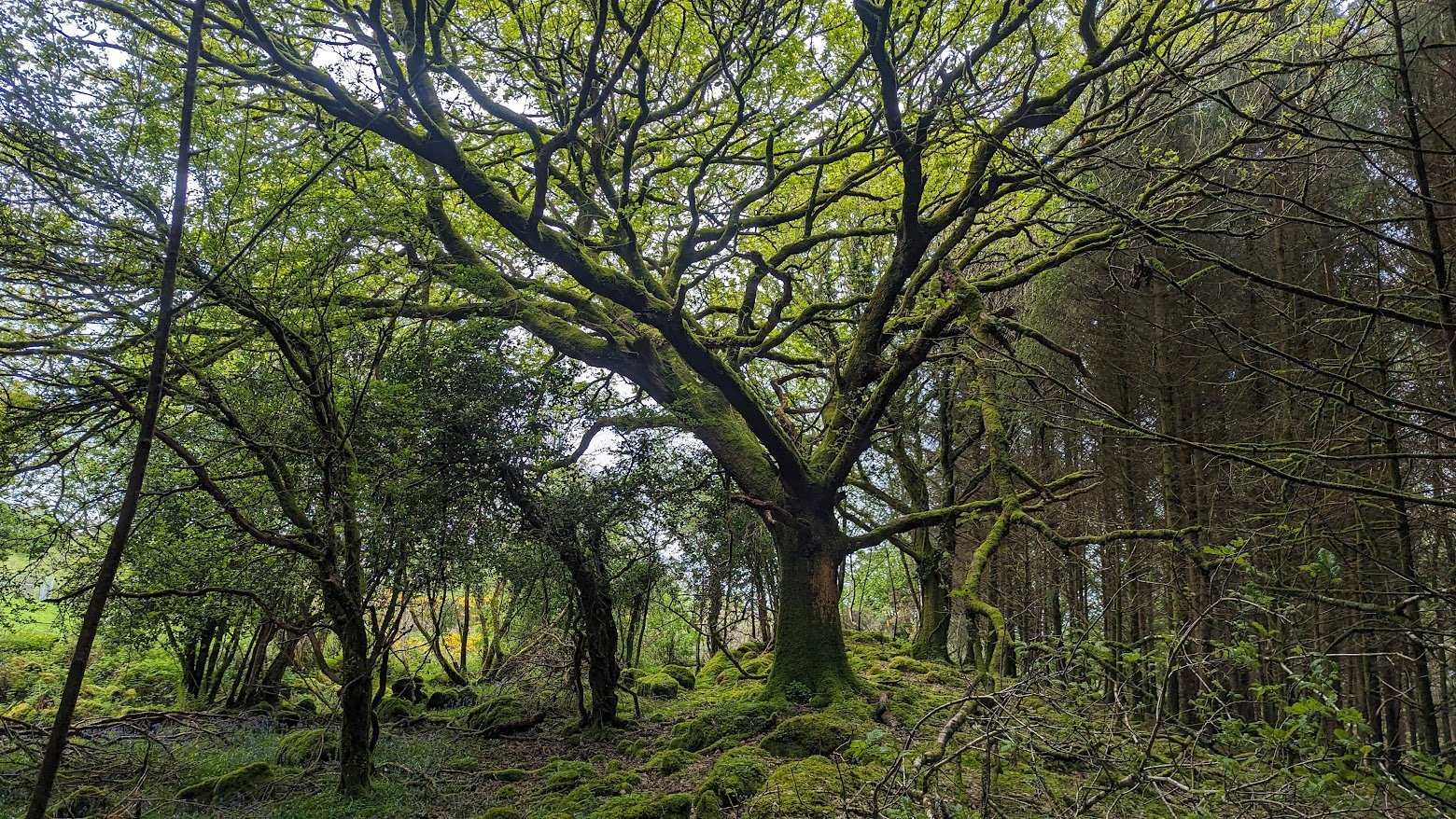
Fragments of the great forest of Aughty cling on, but expanding them without reducing total forest cover on the landscape would be unwise.
We need to find the right places to put new woodlands, but we also need to remove trees from places they should never have been planted in the first place.
Hometree exists to restore and expand native woodlands and their associated habitats. We’re also supporters of sustainably managed commercial woodlands whose primary function is timber production. We need more of all of the above. However, if we are serious about delivering on the true potential of Ireland’s woodlands, rather than simply contributing to crude national tree-cover statistics, we need to ensure that in certain parts of the country, forest cover is actually reduced.
The Slieve Aughty Mountains, straddling south Galway and east Clare, are a good example of where this approach may be required. The Aughties, sitting between Gort, Feakle and Portumna, occupy a landscape with a remarkable woodland history. Remnants of the Great Wood of Aughty (a hiding place of Brian Boru) still survive here, including old oak woods on valley sides and sheltered slopes. These are exactly the kinds of places where native woodland should be protected, expanded and reconnected.
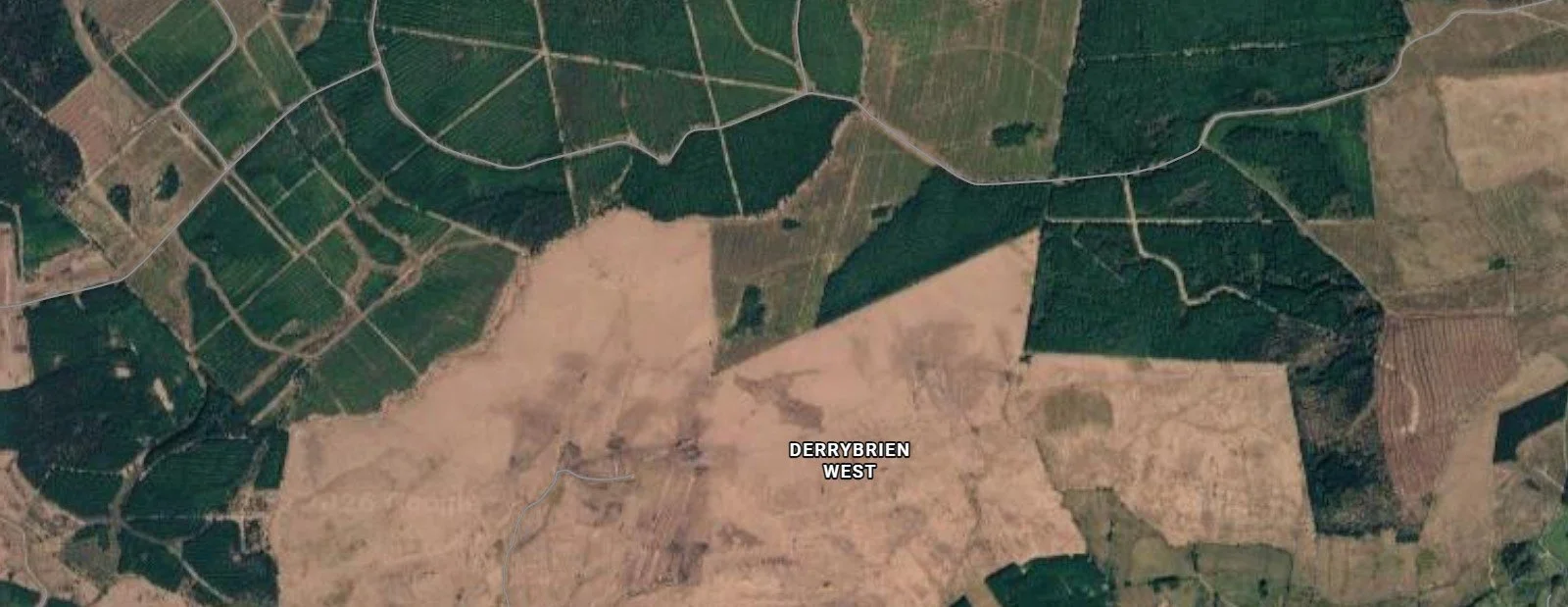
If you want to find some of our naturally treeless landscapes on a modern map, look for these big angular blocks of coniferous forestry.
But the wider uplands tell another story, and not a particularly positive one.
If you want to find some of Ireland’s great naturally open upland landscapes on a modern map, look for concentrations of large, angular blocks of conifers. They are often a remarkably good guide to where our wettest, peatier uplands once lay open.
At the time much of this land was planted, there was a logic to it - rural jobs and economies, building a timber sector, etc. This was the ‘bad land’: places where forestry was seen as having little or no trade-off with agricultural production. What we understand now is that there was in fact a huge trade off - the unique ecology of our open uplands, particularly its birds.
Today, in the Slieve Aughties, roughly half of the Special Protection Area is under forestry, predominantly commercial conifers. A similar story has played out across Ireland’s six breeding Hen Harrier SPAs, with plantations now occupying a very substantial proportion of the landscape.
This is important because these areas were designated for a bird fundamentally associated with open country: bog, heath, rough grassland and scrub.
The hen harrier is now in serious trouble. Ireland’s population declined by around one third between 2015 and 2022. In the Slieve Aughties, the decline has been considerably greater, with only a handful of breeding pairs remaining within an SPA that historically supported many more. Experts would say it is on a pathway to extinction without major intervention.

Bog slippage at the edge of a poorly sited forest in Leitrim.
Of course, forestry is not the only pressure on such birds - agricultural intensification, predators, wind-energy development and wider changes in land management all matter.
Whilst young conifer plantations can provide useful nesting and foraging habitat before canopy closure, problems emerge further down the line when forestry comes to dominate the landscape, creating an ecological trap. As plantations mature, their value to hen harriers declines sharply.
More subtly, the ecological influence of forestry extends beyond the forest boundary. Research in Scotland has found that predators such as foxes and hooded crows can use plantations for cover, nesting and movement before ranging into adjoining open ground, with consequences for ground-nesting birds.
In north-east Scotland, golden plover (another ground nesting bird) numbers fell from 111 birds in 1977 to just 12 by 1985 during a period of rising predator numbers and severe nest losses associated with afforestation. In the Flow Country, separate research found the effects of mature forestry on golden plover and dunlin were strongest within about 700 metres of the forest edge, with predator activity on nearby bog almost three times higher where forestry was extensive.
Ireland’s Hen Harrier Threat Response Plan explicitly recognises these forest-edge effects and associated predation risks. In other words, the ecological footprint of a plantation does not necessarily stop at the forest fence.
The case for selective forest removal is not only about nesting birds. Poorly sited forestry on peat can also damage hydrology, water quality and carbon stores. And in many cases, the ecological argument is reinforced by the economic one: some of these plantations, including state forests, are difficult to manage and produce relatively little timber. There is a broader logic, therefore, to removing forestry from the places where it delivers least and restoring the habitats that belong there.
The Hen Harrier Threat Response Plan currently provides for strategic permanent forest removal within the SPAs, including situations where the normal replanting requirement can be waived. That is an important change in thinking.

Failed tree crop Near Ballinskelligs in Kerry. As well as being damaging to the unique ecology of our bogs and uplands, many of these forests have little or any economic value.
The “right tree, in the right place”, applied retrospectively.
The process is often described as forest-to-bog restoration. A plantation is harvested, but rather than beginning another forestry rotation, drains are blocked and bog or heathland is given the chance to recover.
It is expensive and demanding work. But in the right places, given the edge effect described above, removing one block of forestry can achieve considerably more than restoring the hectares underneath it. It can reconnect open habitat, restore catchment hydrology and increase the effective area available to species such as hen harrier.
We should be prepared to do this at a significant scale. And for Hometree, there is an important principle here: if we are going to advocate credibly for the return of woodlands, we also have to be willing to say where trees should not be.
In landscapes such as the Slieve Aughties, the objective should not be simply “more trees” or “fewer trees”. It should be the right habitats in the right places: less commercial forestry on deep peat and sensitive open habitats, while native or mixed woodland exists where appropriate - along rivers, valley sides, suitable slopes and around the remnants of ancient woods.
We don’t see any contradiction in that.